
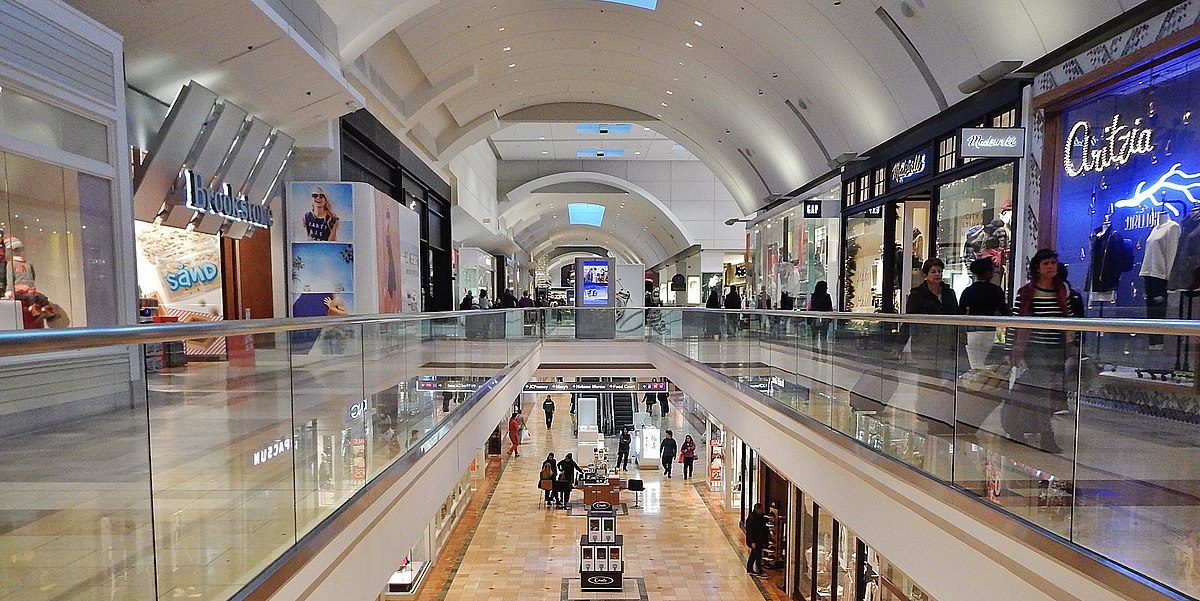
I found myself somewhere unfamiliar today: the Garden State Plaza. I had come to get my phone fixed, and as I started walking through the mall, it occurred to me that it’s been a long time—at least five years, probably longer—since I last set foot here. And maybe because it’s been so long, everything felt louder, brighter, more exaggerated than I remembered. The whole experience felt just a bit surreal.
Everything was bright, loud, and carefully curated—designed to attract, entice, and sell. Consumer culture is nothing new, but seeing it so densely concentrated, so polished and choreographed, caught me off guard.
At one point, I passed a sign for something called “Dopamine Land.” For a moment, I thought I might have misread it. But then I remembered my kids had told me about it—it’s a real place. The name says it all: a space built around stimulation and instant pleasure. In many ways, it fits perfectly into the environment that surrounds it.
Walking through the mall, I was struck by just how much of the experience is about presentation—lights, signs, colors, sounds. It’s not just about things—it’s about convincing us that those things are what we’re missing. It’s easy to scoff at that, but the truth is, all of us get pulled in by it in one way or another.
When my kids were younger and I’d take them to the mall, I had this thing I used to say. We’d be walking through, and I’d turn to them and ask, “What do you see?” And they knew exactly what was coming. I’d say, “You see so many people searching for happiness.” That was my line. They’d roll their eyes—there he goes again—but that’s what always struck me. Not as a critique of anyone, just as an observation. There’s something about a mall that brings it out. All around you, there’s this sense that if you just find the right thing, the next item, the right look, it’ll bring happiness. We’re all searching for something. That’s just part of being human.
And that’s what makes this time of year such a powerful counterpoint. We’re in the midst of Sefirat HaOmer, the seven weeks between Pesach and Shavuot. Chazal describe this time as a journey of refinement, a gradual ascent from the rawness of Yetziat Mitzrayim to the clarity and purpose of Matan Torah. When we left Egypt, we weren’t yet who we were meant to be. We were free, but not yet formed. Over these seven weeks, we work on ourselves. Thought by thought, action by action, we try to become more intentional, more elevated, more deserving.
And then comes Shavuot, the culmination of that work. And what do we bring? Shtei haLechem—two simple loaves of wheat bread. After all that growth, all that spiritual effort, the offering isn’t dazzling. It’s not dramatic. It’s bread.
But maybe that’s the point.
Bread is basic. It doesn’t make headlines. It’s not high-tech or trend-setting. But it’s deeply human. It takes effort. It takes partnership, with the earth, with the sky, with the process. Flour from the ground, water from above. A slow, deliberate transformation. And when it’s done right, it nourishes.
That’s the symbol we bring. Not because we couldn’t do better, but because that is better.
And the contrast is even clearer when you remember what we brought at the beginning of this journey. On the second day of Pesach, we offered the Korban HaOmer—a simple measure of barley. Chazal identify barley as animal food. It represents something raw, undeveloped, even instinctual. That’s where we start. That’s what we’re working with.
Seven weeks later, we bring wheat bread. Human food. Refined, processed, elevated. The shift from barley to wheat marks not just a change in grain, but a transformation in who we are. We’ve moved from reacting to responding, from surviving to choosing, from instinct to intention. And the vehicle for that growth isn’t some shiny object. It’s bread.
This time of year isn’t about consuming. It’s about becoming.
That doesn’t mean material things are bad. Judaism doesn’t reject the physical world—it embraces it. But only when it’s grounded in meaning. Only when we understand that gashmiyus is meant to be a means, not an end.
There’s a phrase in Pirkei Avos—one of the 48 ways Torah is acquired: מיעוט סחורה—limiting one’s involvement in commerce and consumerism. It doesn’t mean one shouldn’t work or earn a living. It means that the pursuit of things can quickly become all-consuming, and when it does, it can drown out the still, quiet work of the soul. The more we chase after what’s outside, the harder it becomes to cultivate what’s inside.
That’s what struck me walking through the mall. It’s all so loud. So designed. So urgent. And then I thought of shtei haLechem—two loaves, sitting quietly at the end of seven weeks of growth. No fanfare. Just substance.
We’re not here to dazzle. We’re here to deepen. We’re not here to collect. We’re here to connect.
So yes, I came to fix my phone. But I left with something else—a reminder that the simple, the slow, the sincere—that’s where real growth lives. The mall sells the next new thing. Shavuot reminds us that the oldest things are often the truest.
And the best things in life? They’re not things at all.
 To Whom It May Concern
BH, the Rav and his family will soon be living in Eretz Yisrael, where indeed the tremendous level of ruchniyus far outweighs the gashmiyus, and R. Rothwachs’ contributions to the spiritual life in Israel will certainly enhance this even more, BE”H. Klita Kala & Ken Yirbu!
—David
LikeLike