
“There is a crack in everything. That’s how the light gets in.” — Leonard Cohen
Rabbi Akiva’s Rebuilding: The Heart of Lag B’Omer
There is a profound paradox at the heart of Jewish history: collapse often precedes breakthrough. Lag B’Omer, which begins this Thursday night and marks the 33rd day of the Omer, represents such a moment. It commemorates the end of a plague that killed 24,000 students of Rabbi Akiva. But more than that, it honors what came next – a decision to rebuild in the face of devastation. It is a day not only of mourning interrupted, but of renewal awakened.
Imagine pouring your life into 24,000 students, only to lose them all in just over a month. That was Rabbi Akiva’s reality. He had begun Torah study at 40, built an academy that changed the world, and then watched it collapse. What followed is what we remember on Lag B’Omer – not just the end of death, but the rebirth of hope.
The Gemara (Yevamot 62b) tells us: “Rabbi Akiva had twelve thousand pairs of students… and all of them died in one period because they did not treat each other with respect.” The Meiri adds: “There is a tradition from the Geonim that on the 33rd day of the Omer, the deaths stopped.”
The Pri Chadash offers a well-known explanation: that the joy of Lag B’Omer does not stem from the mere cessation of the plague—since by then, nearly all of the students had already perished—but from the beginning of something new. He suggests that perhaps the celebration is for the next chapter: for the few students Rabbi Akiva taught afterward, who did not perish like the others.
Still, the Pri Chadash’s answer can feel deeply unsatisfying. After all, 24,000 of Rabbi Akiva’s students died. His entire educational legacy, the community of Torah he painstakingly built, was effectively wiped out. Only a handful remained. So what exactly are we celebrating? This was not a minor setback, it was a near-total collapse. The plague had already run its course. The deaths stopped not because of healing or recovery, but because there was almost no one left to die. It’s like standing in the aftermath of a fire that consumed everything and calling attention to a few scattered embers. How can that possibly be the source of joy?
And yet, says the Pri Chadash, that is precisely the source of our joy. Not because what was lost was restored, it wasn’t. But because Rabbi Akiva found the strength to begin again. Because even when the structure had crumbled, and only a few fragile stones remained, he chose to rebuild. The joy isn’t in what survived, it’s in the decision not to surrender. And sometimes, that decision is everything.
He started again, with just five students: Rabbi Meir, Rabbi Yehudah, Rabbi Shimon, Rabbi Yose, and Rabbi Nechemia. Five students to replace 24, 000. It seemed almost absurd. Yet from those five emerged the core of the oral tradition we rely upon to this day. Chazal teach us (Sanhedrin 86a) that when a Mishnah is recorded without attribution, it is generally attributed to Rabbi Meir, the teachings in the Sifra to Rabbi Yehudah, in the Sifri to Rabbi Shimon, in the Seder Olam to Rabbi Yose, and in the Tosefta to Rabbi Nechemia.
What deepens this insight even further is the tradition that Rabbi Akiva’s rebuilding began not only in spirit, but in action, on Lag B’Omer itself. According to some sources, it was on this very day that Rabbi Akiva gave semicha to Rabbi Yehudah ben Bava. Rabbi Yehudah ben Bava, in turn, later gave semicha to Rabbi Akiva’s five remaining students in open defiance of the Roman decree forbidding it. He did not merely risk his life—he sacrificed it. As the Gemara (Sanhedrin 14a) recounts, he was caught in the act and brutally executed by the Romans. His martyrdom sealed the transmission of Torah for future generations. While the historical details may be debated, this tradition suggests that Lag B’Omer marked not only the end of a tragedy but the beginning of a quiet yet enduring transmission.
At first glance, this might seem like a small gesture in the shadow of overwhelming loss. But in truth, this single act of defiance and renewal may well be the most compelling reason we celebrate Lag B’Omer. It was a bold affirmation that even in the aftermath of devastation, Torah would not only survive, it would endure and flourish. This gives deeper resonance to the Pri Chadash’s insight: our joy is not about what was lost, but about the courage to plant again, even in scorched earth. The rebuilding began small but changed the Jewish world. Rabbi Akiva’s story teaches us that renewal begins not with abundance but with persistence. A single drop of water, falling again and again, can wear away stone.
Hostage Stories and Modern Resilience: Finding Faith in Absolute Darkness
This pattern, of renewal arising from collapse, extends beyond ancient stories. It has continued throughout Jewish history—from the Maharam of Rothenburg and the Rosh to Natan Sharansky—where individuals in captivity clung to faith and identity in the darkest conditions.
Today, we’ve seen it again in the lives of hostages like Edan Alexander and Agam Berger. Edan, a 21-year-old Israeli-American soldier, was held for 584 days and released from captivity earlier this week. Months ago, we were inspired by his grandmother’s public plea to recite Perek 22 of Tehillim, which became a symbol of national prayer and spiritual resolve. His release, like Agam’s, offered not only personal relief but collective inspiration.
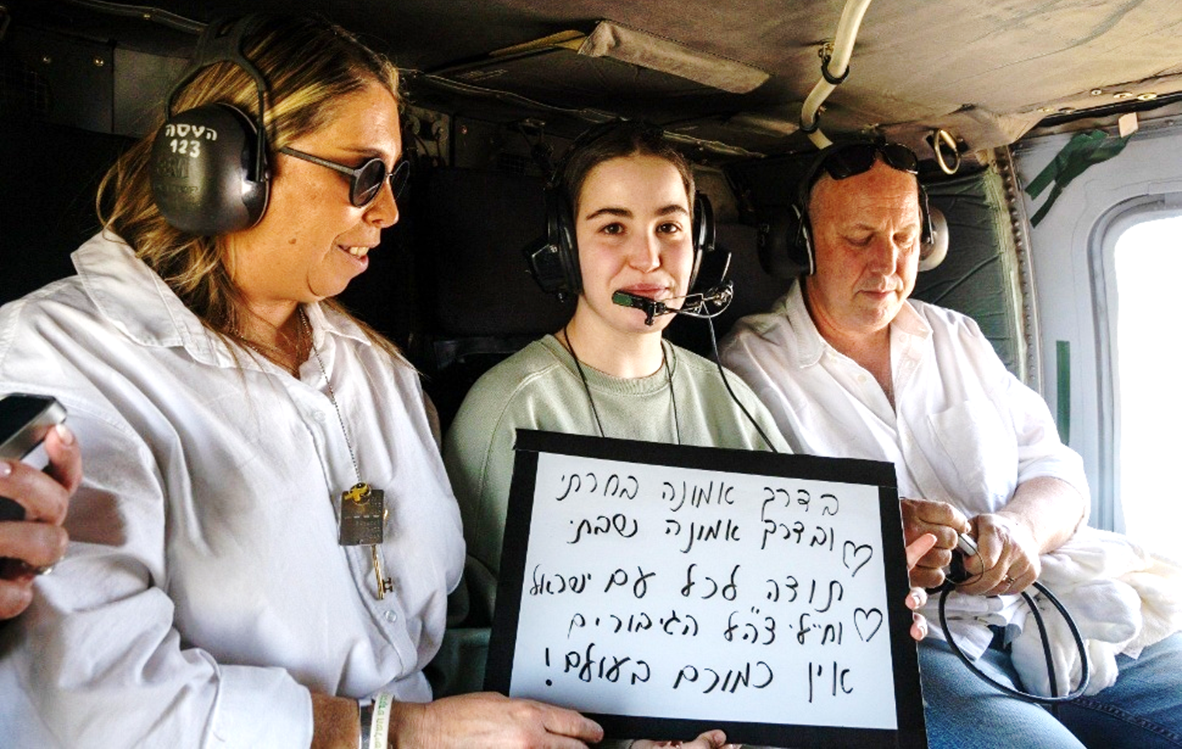
Agam, 20 years old, held for 482 days, became a symbol of strength. She refused to cook on Shabbos, refrained from eating non-kosher meat, and inspired others to fast and pray—even receiving a siddur from her captors. Her mother, Merav, responded not with anger but with mitzvos, encouraging others to be “more Jewish.” Upon her release, Agam held a sign that read: “B’derech emunah bacharti; b’derech emunah shavti – In the path of emunah, I chose; in the path of emunah, I returned.”
These modern stories remind us: resilience is not a relic of the past. The same spirit that burned in Rabbi Akiva’s few remaining students still burns today—in hostages who chose faith, and in families who responded to terror with meaning, mitzvos, and courage.
In her monumental book, The Choice, psychologist and Holocaust survivor Edith Eger writes: “Suffering is universal. But victimhood is optional. There is a difference between victimization and victimhood. We are all likely to be victimized in some way in the course of our lives. At some point we will suffer some kind of affliction or calamity or abuse, caused by circumstances or people or institutions over which we have little or no control. This is life. And this is victimization. It comes from outside. It’s the neighborhood bully, the boss who rages, the spouse who hits, the lover who cheats, the discriminatory law, the accident that lands you in the hospital.
In contrast, victimhood comes from the inside. No one can make you a victim but you. We become victims not because of what happens to us but when we choose to hold on to our victimization. We develop a victim’s mind, a way of thinking and being that is rigid, blaming, pessimistic, stuck in the past, unforgiving, punitive, and without healthy limits or boundaries. We become our own jailors when we choose the confines of the victim’s mind.”
Agam Berger didn’t just survive captivity, she transcended it. Her choices, and those of her family, brought spiritual strength into a place of darkness and transformed suffering into something sacred.
Like Rabbi Akiva, she showed that even when stripped of everything, the human spirit can choose to believe and begin again. Her story, and those like it, reflect a broader truth in Jewish tradition: that descent is often the prelude to ascent. Yosef’s journey to leadership passed through slavery and prison. Moshe’s path to leadership began in exile. Dovid became king only after years of rejection and pursuit. To truly rise, one must first fall, struggle, and wrestle with what is broken.
Living the Principle: Applied Wisdom for Our Darkest Moments
How do we live this?
First, face the collapse. Rabbi Akiva didn’t deny his losses. He accepted the devastation and still chose to begin again.
Second, start with drops, not deluges. He began with five students. Small acts can seed great transformations.
Third, accept that renewal won’t look like restoration. His students didn’t replicate the past; they built the future.
Fourth, remember: you are not the first. Our history is full of people who rose again, who lit fires in the dark.
There is a concept in Kabbalah (which I admit I know very little about) called shevirat hakeilim, the breaking of the vessels. It describes how divine light overflowed the vessels meant to contain it, causing them to shatter and scattering sparks throughout the world. Our task is to gather them, to find the sparks in what’s broken.
Lag B’Omer invites us to see what our history has always known: collapse is not the end. It is often the opening, the hidden ground from which new light breaks forth. The flames we kindle are not mere ritual—they are testimony. They bear witness to a people who, time and again, have chosen faith over despair. The fire of Rabbi Akiva’s few remaining students. The quiet sanctity of a captive who honors Shabbos in a place of fear. This flame, handed down through exile and loss, does not simply tell us that rebuilding is possible. It tells us that rebuilding is inevitable—because it is who we are. It is the eternal fire that refuses to die, reignited each time a Jew chooses to believe, and begins again.
 To Whom It May Concern