
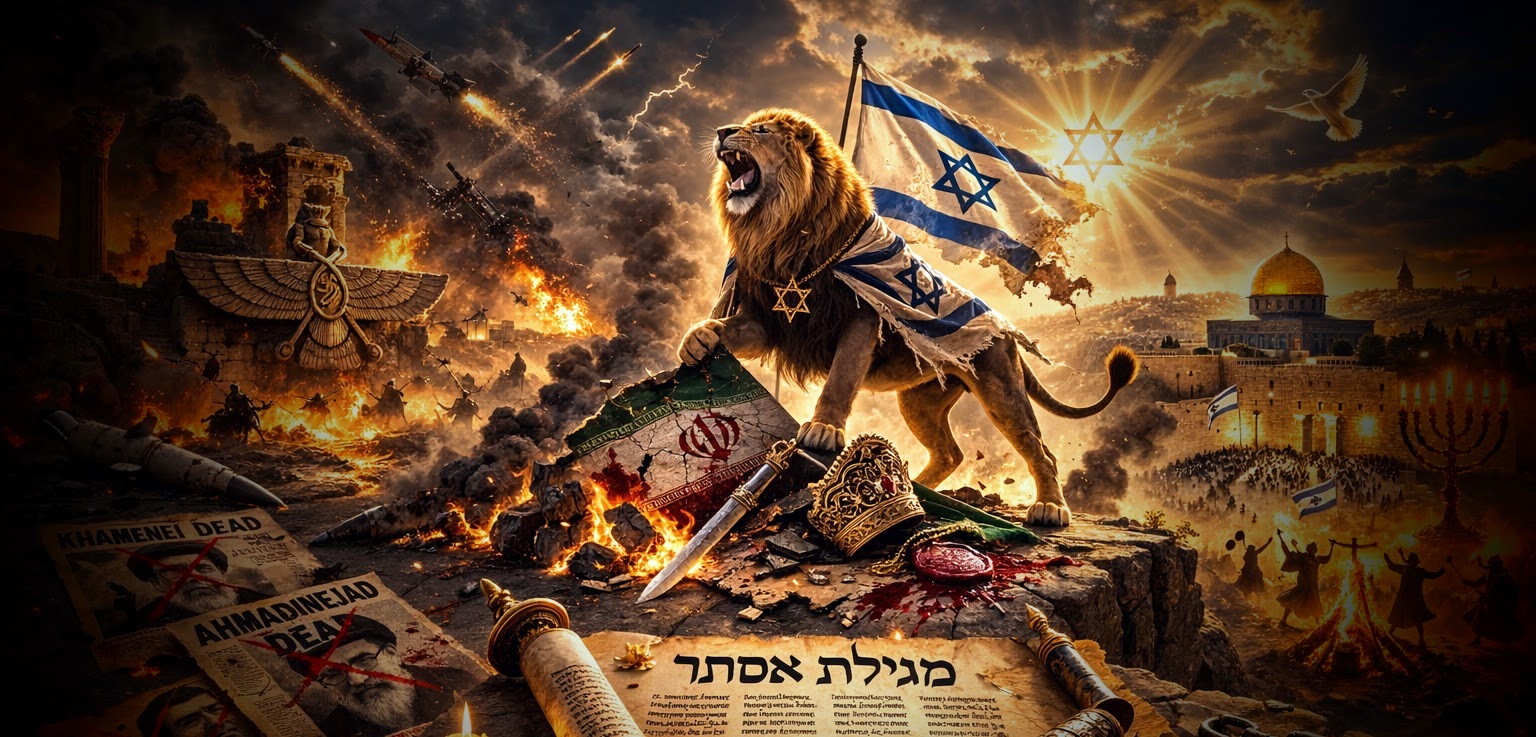
Ayatollah Khamenei is dead. Ahmadinejad is dead. The men who stood before the world and called for the annihilation of the Jewish people — who funded the missiles, armed the proxies, built the infrastructure of hatred, and declared openly that Israel must be wiped from the map — did not live to see Purim. Tomorrow is Ta’anis Esther.
We are about to read the Megillah, the story of the Jewish people and Persia locked in existential confrontation. In that ancient world, too, the language of annihilation was not metaphorical. It was written into law. It was signed and sealed. It was backed by state power. The Jewish people stood vulnerable, scattered, and threatened with extinction. And in that moment, history turned.
Now, on the eve of Ta’anis Esther, Persia once again stands in the frame of our story. Once again, the rhetoric of destruction was explicit. Once again, the intention was operational, not symbolic. And once again, those who devoted their lives to our eradication did not survive to see their plans fulfilled. The timing is not incidental. It is staggering.
The Rambam writes at the opening of Hilchot Ta’aniyot that when upheaval strikes a community, and they cry out, they must not dismiss events as a coincidence. To respond by saying, “This is simply how the world works,” he calls achzariyut — a cruelty of the spirit, a hardening that refuses to engage with moral meaning. A fast is not about hunger. It is about clarity. It exists to uproot the illusion of mikreh.
That word lies at the heart of Amalek’s identity. The Torah describes Amalek as אשר קרך בדרך. Chazal hear in that phrase not only an ambush but a worldview. Amalek represents the theology of randomness. History has no Author. Power explains survival. Coincidence explains everything else. The attack is physical, but the deeper assault is philosophical.
That is why the first communal fast in Jewish history appears in the war against Amalek. When Yehoshua fights below, and Moshe stands above with raised hands, Chazal understand that the nation fasted. Fasting was not tactical. It was theological. Amalek says the world is blind. The Jewish response is to declare that it is not.
Purim represents the maturation of that declaration in an age of hiddenness. In the era of open miracles, the Divine Hand was unmistakable. By the time of Mordechai and Esther, prophecy had receded. The Name of Hashem does not appear in the Megillah. The story can be read entirely as a political coincidence: the king happens to depose Vashti; Esther happens to be chosen; Mordechai happens to overhear; the king happens not to sleep; the chronicle happens to open to the right page. Each event alone is plausible. Together they form a pattern too precise to be dismissed.
Haman himself never abandons the language of chance. ויספר… את כל אשר קרהו — everything that happened to him. Even as events close in around him with frightening symmetry, he insists on mikreh. He calls it a coincidence until the gallows stand ready.
Purim trains the Jewish people to discern meaning when the Divine Name is not explicitly written in the text of history. It does not authorize simplistic conclusions or arrogant certainty. It demands that we refuse randomness.
That is why Ta’anis Esther precedes Purim. Before we celebrate hidden salvation, we discipline ourselves to recognize hidden providence. Before we rejoice in reversal, we confront vulnerability. Before we defeat Amalek’s violence, we reject Amalek’s theology.
In moments like this, it is tempting to reduce everything to strategy and geopolitics. There will be endless analysis of intelligence operations, military precision, deterrence frameworks, and regional realignment. Jewish self-defense is a mitzvah. Strength is not a contradiction to faith. But if we speak only that language, we concede the deeper battle. A fast day insists that history is not merely the collision of power blocs. It is a moral narrative unfolding under a concealed but deliberate Hand.
The Rambam does not permit us to assign specific heavenly motives to specific events. He does require that we respond with introspection rather than indifference. A fast calls for unity, for tefillah, for moral refinement, for the rejection of cynicism. It demands that we not become spiritually numb in the face of extraordinary timing.
We do not glorify death. We do not romanticize conflict. We do not pretend to decode Heaven’s calculations. But we also do not avert our eyes from the irony written into this moment. On the eve of Ta’anis Esther, those who built careers on the promise of Jewish annihilation have fallen. Not in Shushan. Not in the desert. Here. Now. In our lifetime.
Amalek’s war was always both physical and philosophical. The Jewish response must remain the same. We defend ourselves with strength. And we fast to remind ourselves that strength alone does not explain survival.
Nothing is mikreh. Not in the days of Moshe. Not in Shushan. Not on the eve of Ta’anis Esther. Not now.
 To Whom It May Concern