Back To Shul Supplies

Cruising down the aisles of Walmart, firmly holding my (almost) 4th grader’s sweet little hand, as she excitedly waved her freshly printed school supply list,  I could not distract myself from one particularly gnawing thought, which relentlessly clamored for my attention; why were two pink erasers needed for the year ahead? After all, would one eraser not suffice?  Especially given that these days the built-in eraser option comes standard on all new pencils. Maybe it’s just me but I personally don’t recall ever coming close to wearing down a pink eraser, facing the sudden urgent need for a replacement. On the other hand, I can certainly appreciate why two glue sticks are needed.  (We actually got three, just to be safe.)  I was also pleasantly surprised that we only needed to purchase one box of Mr. Clean Magic erasers and was similarly gratified that this year’s list only called for six erasable pens.  As some may recall, last year we needed eight.

Unquestionably, there is something special about the return to school. Granted, most of our children prefer the joyful sounds of splashing water and smells of outdoor fun to that of school bells and yellow buses. Adjusting bedtimes, adapting to new schedules and becoming acclimated to more structured settings, certainly comes with challenges.  But filling up one’s supply box with freshly sharpened pencils and gently opening a package of 300 blank sheets of paper, triggers thoughts of optimism and feelings of hope.

Although for many of us, our years of formal education have come to an end and we are not necessarily in “back to school” mode, we are surely preparing for our imminent return “back to shul.” Hopefully, most do not need to prepare for a literal reentry, following a multi-month hiatus from shul.  At the same time, many of us yearn for the unique opportunities of inspiration and special moments of connection that are often more naturally experienced during the month of Tishrei.  This is, after all, the season of teshuva, the season of return.

As we prepare to return, I wonder what our supply list should look like and what materials we should be preparing at this momentous time.  Here are a few suggestions:

RULER: In order to plan for a successful year, one must have the tools to properly and accurately measure change. Have I grown since last year? If so, how much?  As change typically occurs gradually, it is critical that we identify the proper tools that will enable us to quantify and track those changes and trends.

ONE MARBLE NOTEBOOK: The process of teshuva requires cheshbon henefesh, a thorough and comprehensive inventory of the soul.  This can only be properly achieved through a system of accounting, calculating and logging. Coming to shul with an actual notebook in hand, while completely appropriate and commendable, will likely be too awkward for most. Yet to rely on extemporaneous thoughts and spontaneous memory alone reflects a profound lack of appreciation of the complexity of the human mind and soul, not to mention the extraordinary challenges and opportunities of teshuva.

SCISSORS: One of the most challenging, and at times painful, stages of teshuva, is the internal dissection that true repentance often requires. Breaking habits and reforming attitudes entail the excision of targeted behaviors and indulgences, coupled with the commitment to let go of all that obstructs my path to personal freedom.

BINDER: Often we begin the new year with many goals and aspirations. We earnestly consider countless resolutions, both new and recycled, identifying numerous areas for needed change and improvement. If we truly want to be successful, our resolutions should be very few in number. Perhaps just as important though, our new year’s resolutions must be carefully bound together and incorporated into a carefully coordinated plan for implementation and sustainability.

REINFORCEMENTS: Lasting change cannot occur in a vacuum.  We need to commit ourselves to lifestyles which support our commitments and dreams. Our social connections and moments of leisure must reinforce the ideals and values that we seek to maintain.  Anyone can make a New Year’s resolution.  Without reinforcements, however, they are doomed to fail.

4 FOLDERS WITH PRONGS: I have no idea but could never hurt.

TWO BOXES OF TISSUES: We should prepare to invest ourselves emotionally as we commit to the grueling, yet redemptive, process of teshuvaTeshuva, like prayer, is an avoda she’balev, a service of the heart.  As we stand before God and confess our sins, we repeatedly strike our hearts, reminding ourselves of the need to be genuine and sincere.

SCOTCH TAPE: Teshuva gemura (complete repentance) can indeed enable one to achieve a state of pristine purity and complete and absolute renewal.  Thankfully though, that’s not the only option. Often times, we can successfully apply tape to those parts of our soul that are torn and tattered. Emerging from the days of awe with temporary repairs and loose ends is not a reflection of failure.  To the contrary, partial repairs enable us to remain mindful and aware of our weaknesses and shortcomings, thereby improving the likelihood that we will successfully protect and reinforce our fresh stitches and patches.

As we each prepare to return to shul in the days ahead, we should make every effort to identify and gather the tools and materials that we will need to achieve success.  Unlike school lists, there is no single list that will enable each and every individual to be prepared for the first day.  So, let us spend these final hours before the start of the new year, replacing, replenishing and restocking so that we gather all that we need to succeed in the days ahead.  But, please don’t delay.  Hurry – while supplies last.


Generous to a Fault

Consider the following statements:

  • “Clean up the mess that you made.”
  • “Go find the keys that you lost.”
  • “Fix the window that you broke.”
  • “Throw out the food that you burned.”

Granted, in the absence of any context and additional information, it is difficult, if not impossible, to offer an informed opinion regarding these statements. Are these accusations fair? Are the complaints warranted? Perhaps. Perhaps not. With such an incomplete picture, we can never know. What is clear however is that these expressions reflect genuine resentment, harbored by an individual who makes no effort to conceal the grudges that he bears.

It is remarkable therefore to consider the following. When God informs Moshe to prepare a second set of luchos, as a replacement for those which Moshe had destroyed, He says, “Inscribe these tablets with the very words inscribed on the first tablets – the ones that you broke.”[1]  Rather than merely communicate His instructions, Hashem takes the opportunity to “remind” Moshe that it was his (i.e. Moshe’s) personal and unilateral decision to destroy the luchos.  Surprisingly, however, rather than interpret this expression as one of resentment and disappointment, our rabbis come to the exact opposite conclusion. They regard this statement as an explicit endorsement; Hashem’s clear declaration of approval of Moshe’s bold decision to break the luchos.[2]  This interpretation however, seems quite surprising.  Would it not be more reasonable to conclude that God’s reminder to Moshe of his actions was nothing more than an expression of disapproval and denunciation?

Rav Baruch Epstein z”l [3] offers an extraordinary insight, with profound and relevant implications.  Indeed, most often people cannot resist the temptation to remind another of their missteps and indiscretions. Stating the blatant and obvious failures of another affords one a momentary sense of satisfaction and superiority. While this may very well be human nature, there is one problem; doing so is both insensitive and improper. It is unnecessary to remind a child that it was he who made a mess. It is unproductive to remind one’s wife that it was she who lost the car keys. It is pointless to remind one’s husband that it was he who forgot to remove the food from the oven. Yet, many of us are guilty of doing just this. We do so primarily because we are human and because, at times, we lack the resolve to exercise self-control, particularly at moments when our patience is being tested. Not so by God. Hashem is perfect in all of His ways and His words reflect precision and they model refinement. Therefore, argues Rav Epstein, the very fact that Hashem “reminds” Moshe that it was he who had destroyed luchos, in and of itself, proves that Moshe’s unilateral decision was met with divine consent and approval.  Had destroying the luchos been, in fact, the wrong decision, there would have been no need to remind Moshe of that which he already knew.

What a profound example of proper behavior for each of us to model and emulate. For most of us, moments of disappointment and frustration with other individuals, particularly with those who are close to us, are not uncommon occurrences. How we handle ourselves in these situations, will likely determine the extent to which we succeed in inspiring others towards genuine reflection and motivate sincere change.  The Torah [4] instructs us to emulate the ways of God. While we can never achieve perfection, we carefully study His ways, ever so closely, as we strive to model His precise and deliberate instructive behaviors.

So, the next time someone messes up and, in the process, lets us down, let us resist the temptation to remind them of that which they already know.


[1] Shemos 34:2 and Devarim 10:2

[2] Bava Basra 14a

[3] Torah Temimah and Tosefes Bracha, Devarim 10:2

[4] Devarim 11:22

An Open Letter to the Orthodox Community: Don’t Say No to Drugs

In 1982, Nancy Reagan visited the Longfellow Elementary School in Oakland, CA, as she embarked on her historic national anti-drug campaign.  During this visit, she was asked by a young schoolgirl what she should do if she was offered drugs. The First Lady responded, “just say no.”  The rest, as they say, is history. “Just Say No” clubs and organizations were established all over the country and one of the most famous slogans in modern times was born.  The “Just Say No” rallying cry has since become ingrained in the minds of hundreds of millions of people, spanning all races, ethnicities, and religions.

I wonder however if the Orthodox community has taken Mrs. Reagan’s instructions a bit too far.  Indeed, we can all agree that the only proper response from one who has been solicited to accept drugs is “no.”  Too often, however, many of us express “no” to the mere suggestion that we discuss drugs at all.  Many of us naively believe that the Orthodox community is, more or less, unaffected by the drug epidemic, which so dreadfully affects the general population.

Consider the manner in which many well-intentioned members of our community would likely respond to the following questions:

  • Do substance and alcohol abuse and addiction affect members of the Orthodox community, to any significant degree?
  • Should we, as a community, organize public gatherings to discuss how best to detect alcohol and substance abuse and introduce methods of intervention and treatment?
  • Do substance abuse and addiction afflict individuals who come from supportive families and functional households?
  • Do people who are committed to a life of Torah observance and seek to embrace Torah values abuse alcohol or drugs?
  • Do individuals who truly appreciate the value of self-control struggle with alcohol or drug addictions?

Did you answer “no” to any of these questions?  If you are like most of us, then you probably have.  The uncomfortable truth, however, is that the answer to all of these questions is a resounding “yes.”

  • Yes, substance and alcohol abuse and addiction undeniably affect a significant population within the Orthodox community.
  • Yes, we must absolutely come together as a community and discuss methods of detection, intervention, and treatment of alcohol and substance abuse.
  • Yes, substance abuse and addiction often affect members of supportive families and functional households.
  • Yes, it is not uncommon for individuals who are genuinely committed to Torah observance and values to develop addictions to alcohol and drugs.
  • Yes, most often, individuals who struggle with alcohol and drug addictions thoroughly and deeply understand, appreciate, and value the virtue of self-control, despite their destructive behaviors.

But why the disconnect?  Why does our community so glaringly miss the mark on this particular issue?  After all, our community consistently displays profound sensitivity to the needy and disadvantaged, demonstrates care and concern for the weak and vulnerable, and is typically proactive in addressing the myriad of social issues that affect the members of our community.  Why then do we seem to possess a lapse in awareness and deficient sensitivity when it comes to the issue of alcohol and substance abuse and addiction?  It is my impression that many Orthodox Jews (simply) lack information, exposure, and context, all of which would enable us to develop a more informed, nuanced, and accurate perspective of the reality.  Our detachment from the facts on the ground does not reflect insensitivity or indifference.  Rather, our disconnect is, among other things, a reflection of our limited exposure, inadequate education, and impaired understanding.

Whatever the underlying causes of our disconnect may be, its effects, albeit unintended, are no less harmful and destructive.  The common misconceptions that we, as a community, continue to harbor and, at times promulgate, clearly and predictability obstruct our collective ability to responsibly and effectively address substance abuse and addiction. The longer we maintain the belief that members of our community are either immune to or unaffected by alcohol and drug abuse, we fuel the fires of stigmatization, causing our very own friends and neighbors to shoulder their hefty burden alone.  The longer we allow ourselves to view the families of those who suffer from addictions with prejudice and presume their shared culpability in their child’s/spouse’s/sibling’s/parent’s addiction, the further we estrange those who desperately need comfort, support, and reassurance.   The longer we view alcohol and substance addiction as a failure of character, rather than what it actually is – a physiological illness, we further alienate members of our community who may already feel helpless and ashamed.  As individuals, we must band together and inspire a paradigm shift in the way we approach alcohol and drug addiction, recognizing it for the illness it is.  As a community, we must hold ourselves accountable, knowing that there are those among us who are afraid to come forward and step into the light, lest they be unfairly judged, mislabeled, and misunderstood.  We must learn to encourage and embrace those struggling with addiction, as well as their families, assisting and supporting them on their road towards healing and recovery.

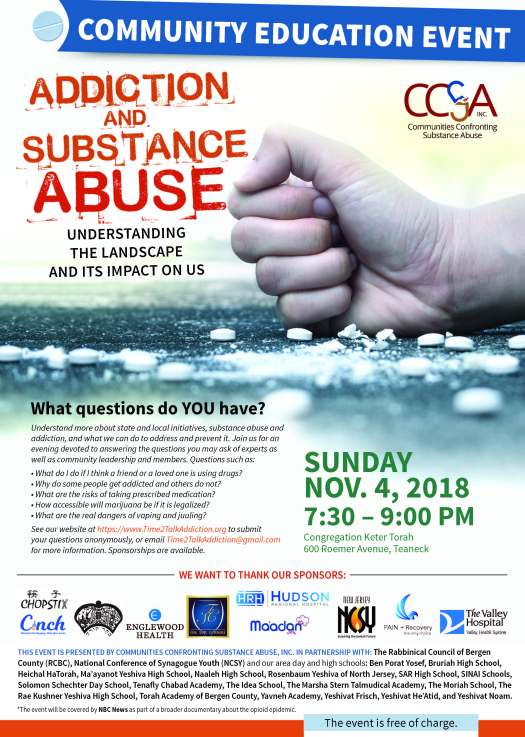
Needless to say, success in achieving such a radical and fundamental shift in thinking and action will take time, effort, and coordination to actualize. But we need to start and that time is now.  Please join me on April 22 at 8 p.m. at TABC, for an important community awareness event, coordinated in conjunction with Amudim.  Participants of this event will become more informed and enlightened regarding the growing epidemic of substance abuse and addiction within our community.  With your participation, this event can be a major step forward for our community.  However successful this event may ultimately be, it will be a starting point, with more work to follow.  I hope this event will inspire our community to slowly but surely create an environment where families can comfortably seek and easily discover support.  And then we, a more attentive and informed community, will more naturally strive to sustain and nurture that supportive environment.  I hope and pray that we demonstrate the courage, commitment and resolve to restore peace and health to all in our midst.

Awareness Event - FULL PAGE

The Spaces in Between

Let’s face it – technology has taken over our world. In countless ways, today’s amenities and style of living seem like the stuff of yesterday’s science fiction.  For better or for worse (or both), every sector of our life has been dramatically transformed through technological advancements.  Perhaps the most astounding development over the past several decades is the accelerated pace of technological progress and change.  Ever-increasing processing speeds, the continued expansion of digital storage capacity and remarkable improvements in the technology of automation, have enabled us to achieve yesterday’s goals in a fraction of the expected time and realize tomorrow’s dreams, what appears to be, ahead of schedule.

Unfortunately, this new, fast-paced reality leaves us with little or no time to stop, reflect, think, and process.  There was a once a time when we truly appreciated the qualitative value of moments of reflection.  Some may have even deemed these moments as essential for healthy living. Breaks in our routine afford us the opportunity to introspect and self-analyze, both thoughtfully and critically.  Moments of boredom and disconnect allow us to plan methodically and responsibly.  But when life whisks us from one frame in time to the next, without pause or interruption, we are denied these precious opportunities for reflection and growth.  In our technologically advanced era, the pauses, breaks and the natural staccato of our behavioral routine, have been all but eliminated and supplanted with “new and improved” lightening-speed, high-definition, streaming lifestyles.

There is something else as well.  Breaks in time have an added value, in that they allow us the opportunity to cherish the moments in life that seem extraordinary and appear transcendent.  Whether we are experiencing God’s amazing blessing and bounty, or even when faced with a personal setback or loss, such moments are experienced with an enhanced appreciation when we are afforded the opportunity to close our eyes, breathe, and take in the moment for all it is.

One of the most stunning moments in our history was kerias yam suf, the splitting of the sea.  With the Egyptian army in high pursuit and the deep and raging waters ahead, it appeared as if our liberation would be short-lived and our moments of joy and elation would be transformed into tragedy and misfortune.  And then suddenly the tide turned (literally) in our favor.  The sea opened and embraced our people, while simultaneously crushing and defeating our relentless enemies.  As we know, this spectacular moment was received by a grateful people, who responded with a united and publicized outpouring of song and praise.  The shiras hayam has been memorialized and preserved in our hearts, as we recite these words each and every day.

A closer look at the Torah text, reveals a message which is incredibly profound.  In the Torah scroll, the shira is written ariach al gabay l’veina; every line is occupied with text, as well as empty spaces.

shira 2

This remarkable textual anomaly conveys a message which is essential for our generation.  When inspired by an awesome moment, we express ourselves with words of song and thoughts and praise.  We employ all of our intellectual and emotional resources in an effort to mine the reservoirs of human vocabulary. We commit ourselves to this task because we hope, at least to some degree, to capture transcendence and then, on occasion, we boldly attempt to preserve it in ink.  But this is only half the challenge.  When experiencing an awesome and transcendent moment, we must recognize that there is another dimension, which can only be captured and preserved through pauses, breaks and, at times, through silence.  These empty spaces do not express disruptions in thoughts or emotion.  These pauses are not meant to convey confusion nor a lack of awareness.  To the contrary, it is precisely when we peer deep into the spaces that lie in between the words, that we can achieve an enhanced level of perception and insight.

Last week, I was blessed to hold my first grandchild.  As I stared at her for the first time, my eyes simultaneously locked on the breathtaking view of the Jerusalem sunset, my heart and mind were flooded with emotion.  I will not dare an attempt to describe that remarkable moment, as I recognize from the outset that failure is all but inevitable.  But, I can say with certainty, that this moment was, and continues to be, experienced not through the high-definition and brilliant text of life, but rather in the pause and in the silence of the blank spaces that lie in between.  I am deeply grateful that although I spend way too much time huffing and puffing on the treadmills of technology, I am still able to access the pause feature in my heart and mind.  I am grateful because I am absolutely convinced that there are moments in life that I don’t want to be streamed and shared.  And, for whatever it’s worth, I remain determined to resist the mounting counter pressure that constantly stares me down.

I truly hope that my children manage to secure and preserve their natural capacities to pause and reflect.  Perhaps their generation will ultimately come to realize that certain moments cannot – and should not – be captured, recorded or uploaded.  Finally, I pray that as our world continues to speed forward and achieve unprecedented levels of acceleration, we succeed in forever appreciating the empty spaces that lie in between.


Free Will or the Will to Be Free?

Freedom is in the air.  Following weeks of focused preparation, we will soon gather in our homes and synagogues, in observance of Pesach, the festival of our freedom.  Our annual celebration of yetzias mitzraim reminds us to recognize and cherish our gift of eternal freedom, cheirus olam.  Although 3300+ years have passed since the Exodus, there is still plenty of freedom for us to celebrate; arguably, more than ever before.  We enjoy unprecedented religious freedom and economic opportunity, both of which have enabled the exponential growth of our communal infrastructure.  Profound advancements in technology allow us to communicate freely with family and friends all over the world. Global (and even local) travel has never been easier and there are very few barriers, if any, between us and anyone with whom we are seeking to connect.  And so yes, it would seem that we have never been freer than we are today.

Remarkably however, there do appear to be several indications that our path towards absolute and demonstrable freedom may be partially obstructed.  Does modern man truly possess the freedom to exist, live and choose voluntarily?  If that were indeed the case, then we would likely observe widespread contentment and happiness.  Genuine freedom would allow individuals and families to demonstrate passion and commitment to the preservation of their values and achievement of their goals.  If we were truly free, we would constantly ascend to new heights of self-awareness and achieve new levels of self-control.  Yet, numerous studies (do we really need data anyway?), indicate that in all these categories, we were once better off than we are today.

Why is that so? Shouldn’t our freedom to live, to be, and to choose, enable us to experience true happiness, commitment, satisfaction, and fulfillment?  Why do our lives, so suffused with freedom, appear to leave us with the constant nagging feeling that there is so much more to be desired?

There are undoubtedly many different paths to explore if we are to properly address these questions.  For the moment though, it may be helpful to consider the inherent value in simply asking ourselves these questions, even without pressing forward, in search of specific answers.  Honest and critical examination of the widely held assumption that we do, in fact, choose purposely and freely, may allow us to discover much about ourselves and the real driving forces in our life.  And we should not stop there.  Rather, in the spirit of the Pesach experience, let us share these questions with others and discuss them with the members of our family.  Perhaps consider these additional challenges, in an effort to achieve deeper insight and greater perspective regarding our personal freedom:

  • How often do I feel that I can express myself freely and speak genuinely?
  • How often am I able to secure the time to devote to the things that I truly want to accomplish?
  • How often do I say, “I can’t because I’m too busy” or “I just wish I had more time”?
  • To what extent does technology enable me to achieve more of my life’s goals? In what ways does technology interfere and, at times, obstruct these efforts?
  • Do the conveniences and efficiencies of technology enable me to better manage my time and discover new opportunities for growth?
  • Do the marvels of modern communication enable me to achieve greater satisfaction and fulfillment in my relationships?

If you are like me, confronting these questions generates a degree of inner discomfort. We are faced with the realization that although modern man has succeeded in achieving unimagined feats and accomplishments, our existence, in many ways, seems quite confined and our choices seem remarkably limited.  Our freedom, while ours to be claimed, seems forever elusive, evading actualization.

And so, as we celebrate zman cheiruseinu, the festival of our freedom, let us challenge ourselves with the following question: do I truly possess freedom of will or do I simply carry the will to be free?  Only after we have asked ourselves this question, may we begin our journey in search of answers.


It’s About Time

You only get one chance to make a first impression.  Our initial encounters profoundly shape and define our experiences and relationships. And so, as we prepared for our exodus from Egypt, those first moments were exceptionally critical. It is not surprising, therefore, that at that fateful moment in time, Hashem presented our fledgling nation with a lengthy and detailed series of instructions, as our formal entry into the world of mitzvos was set to begin. Remarkably, the very first mitzvah given to the Jewish people is Kiddush HaChodesh, the sanctification of the new month.  This mitzvah, which serves as the basis of our calendar system, is essential for the functioning and maintenance of numerous aspects of our ritual observance. It is somewhat peculiar, however, that this particular mitzvah, of all mitzvos, should be the very first given to the Jewish people. The Jews who were preparing to leave Egypt at this time were not yet a committed and God-fearing people. They were emotionally fragile, spiritually immature and on the verge of complete assimilation, many of them still profoundly confused regarding their true loyalties.  One has to wonder, therefore, why the Master of the Universe chooses the platform of kiddush hachodesh upon which to make His initial introduction.

The Seforno (Shemos 12:2) observes how this monumental point in history was a critical juncture in time.  At the moment of liberation, the Jewish people would undergo a transformation, transitioning from slavery to freedom. With this transition, control over one’s time is transferred, from master to newly emancipated slave.  Enslavement denies the individual the ability to manage and use his time autonomously. A slave is coercively subjected to the wills and whims of his master, thereby denying him any personal control over his time or schedule.  With liberation, this all changes.  Suddenly, personal autonomy over one’s time, as well as the ability to manage that time, is reinstated. It is at this point in history, says the Seforno, that our existence as a people who possess the ability to make meaningful choices, officially commences.

The degree to which we properly manage our time reflects, to a certain extent, how much we truly cherish our freedom.  While many of us are often immersed in a multitude of tasks, running from one appointment to another and gasping for time, as if struggling for another breath of air, we do possess the ability to control our time, perhaps more than we realize.  Difficult choices need to be made, yet by recognizing how valuable our time is, we can choose to elevate our days by sanctifying our hours.  Occasionally, painful sacrifices must be undertaken, but by making responsible and deliberate choices as we manage our schedules, we can enrich our minutes by being more mindful of the passing seconds.  It is not an easy task; far from it. Yet there is no more appropriate way to celebrate the beginning of the month of Nissan, than through a renewed appreciation of the incredible and irreplaceable gift of time.

Please consider the wisdom of the following parable, author unknown: Imagine there is a bank that credits your account each morning with $86,400. It carries over no balance from day to day. Every evening deletes whatever part of the balance you failed to use during the day. What would you do? Draw out every cent, of course!

Each of us has such a bank. Its name is TIME. Every morning, it credits you with 86,400 seconds. Every night it writes off, as lost, whatever of this you have failed to invest to good purpose. It carries over no balance. It allows no overdraft. Each day it opens a new account for you. Each night it burns the remains of the day. If you fail to use the day’s deposits, the loss is yours. There is no going back. There is no drawing against the “tomorrow”. You must live in the present on today’s deposits. Invest it so as to get from it the utmost in health, happiness, and success.

The clock is running so make the most of today.

Chodesh Tov!


Purim, Alcohol and the Messages We Send: A Call for Consistency

It’s hard to believe but Purim is just around the corner. In less than two weeks, Jews all over the world will gather and celebrate a day endowed with meaning and infused with joy.  Purim provides adults and children with the opportunity to connect with God and with each other in a remarkable way, offering an experience which can be impactful and, at times, transcendent.  Many enjoy cherished memories of Purim celebrations which inspired sustained periods of growth and elevation.

One of the unique features of a traditional Purim celebration is the excessive consumption of wine. Although there is a Talmudic basis for this practice, many rabbinic scholars have established limits and set specific parameters, in an effort to dissuade individuals from becoming intoxicated.  Among the great rabbinic authorities who have advocated such an approach, are Nimukei Yosef (Megillah 7a), Rama (O”C 695:2), Chayei Adam (155:30) and Aruch Hashulchan (O”C 695:3-5).  It is not my intent to offer my own view regarding the halachic definitions and parameters of alcohol consumption on Purim. It would be presumptuous (and irrelevant to most) for me to express an opinion regarding this matter. Our rabbis have presented a remarkably wide spectrum of views, all a matter of public record.

For full disclosure, it has never been my personal practice to become overly intoxicated at a Purim seudah.  Yet, for my entire adult life, I enjoyed the practice of drinking considerably more wine than I did on any other day throughout the year (which, admittedly, is not all that much).  Our personal Purim seudos have always been especially celebratory and festive, reflecting deep and genuine expressions of religious emotion and joy. I will not deny that these experiences were sharply enhanced by the impact of our collective alcohol consumption.

For the past several years, however, I have consciously limited my alcohol consumption on Purim to no more than a single token drink.  This deliberate choice was proudly broadcast to the other participants, most of whom chose to follow this lead. What initiated this sudden change of practice? What precipitated such a significant departure from our customary Purim experience?

Truthfully, I cannot point to a particular event which motivated this change. It was not a reaction to a specific experience, nor a developing crisis in my life. My personal decision to abstain from alcohol on Purim is driven by a desire to communicate clear and consistent messages to myself, my family, and anyone else who may happen to be paying attention.  As a father, as a rabbi and as a teacher, I find it increasingly more challenging to effectively promote intolerance towards excessive alcohol consumption throughout the year, while simultaneously tolerating such indulgences on Purim.  For many, particularly among our youth, the perceived disparity between these two messages is both glaring and compelling.  Our commitment to teaching the value of self-control and our continued efforts to promote intolerance for drugs and alcohol are not merely obstructed by this apparent behavioral contradiction; they are entirely compromised.  To be clear, I do not have the slightest temptation to dismiss or revise Talmudic texts, nor do I intend to imply any grievance with our sacred traditions. On the other hand, Purim does not exist in a vacuum.  With the setting of the sun and the cleansing of our bloodstreams, our religious obligations, social challenges, and personal struggles all resurface and are they right where we left them before the festivities began.  Is it realistic to assume that we can effectively communicate and inspire the virtues of self-control, while faced with conflicting messages that are, for the most part, too nuanced to reconcile?

Additionally, it is no secret that many in our community suffer, directly or indirectly, from the devastating effects of alcohol abuse.  While many of us are able to enjoy the harmlessly benign effects of alcohol consumption one day a year, others among us suffer from the torment and misery of alcohol abuse every day of their lives.  How do we, as individuals and as a community, indulge so excessively, while simultaneously protecting and supporting those among us who may be painfully triggered by our actions? Is it even possible to participate in planned and organized intoxication without provoking sadness, pain, or grief among those most vulnerable and afflicted?   

I offer these questions without presuming to have all of the answers. For myself, the decision to celebrate a dry Purim seems most appropriate and responsible, given my current surroundings and circumstances.  Of course, I will continue to cherish the memories of past Purim celebrations, powerfully enhanced by the alcohol accompaniments.  I will not attempt to forget nor revise the inspiring memories and impressions that were created by rebbeim who radiated joy and transcendence, while under the simultaneous influence of alcohol and Torah.  For now, though, I pray that my children, students, and peers can discover meaning and find inspiration in other opportunities that the day of Purim offers.  We may, in fact, miss the alcohol-induced joy of Purim.  Regardless, we’ve got bigger issues to deal with at the moment.

On Substance Abuse, Parenting Doesn’t End With Open Dialogue

children-must-be-supervised-sign-k-0214I applaud The Jewish Link for addressing the issue of substance and alcohol abuse in the yeshiva community, one of both profound and critical importance. As the article and editorial correctly indicate, sticking our heads in the sand and pretending that this is not an issue of great concern in our community, is naïve at best, reckless and immoral at worst. Indeed, awareness and education, for both parents and teenagers, is an essential measure, if we are to address this problem comprehensively and responsibly. I agree as well that open communication, honest discussion and ongoing dialogue between parents and teenagers, are indispensable tools that must be fully employed throughout this process.

It does seem to me, however, that there is an important component that was absent from your editorial coverage. While parents must work to arm their children with the skills to protect themselves and explain the devastating effects of alcohol abuse and drug use, the role of a parent does not end there. Many of the situations in which our teenagers find themselves in-over-their-heads are facilitated by the parents themselves, albeit unwittingly. Often times, due to our passive compliance, our teenagers find themselves in situations where the temptations and pressures competing for their attention are simply too powerful and overwhelm their under-developed prefrontal cortexes. It is not necessarily education and information which our teenagers lack, nor is it even a lack of motivation on their part. They simply do not have the psychophysiological wherewithal to safely manage and navigate these situations on their own. When (if) we sit down with our children and discuss the dangers of drugs and alcohol, it is very possible that they are listening, tuned in and processing. But, in no way whatsoever, does not mean that they possess the cognitive or emotional ability to make responsible choices in every setting.

To be frank, it is shocking and deeply disappointing how permissive many parents are when parenting the teenage yeshiva community.  Parents often worry that establishing clear expectations and setting appropriate limits, will possibly create a wedge between them and their children, thereby compromising and obstructing the lines of communication. Parents do all they can to avoid saying “no” to a child, out of a deep-seated fear that setting limits will trigger rebellious tendencies. This fear is amplified when teenagers challenge their parents with the proverbial “but everyone else’s parents allow it.” (Recently, a parent actually issued the same rationalization to me!) These concerns are, for the most part, unfounded and often reflect the parent’s own insecurities.

I fully recognize that we cannot, nor should we, attempt to monitor our teenagers’ every move. It is important for teenagers to develop as self-sufficient adults, which necessitates both poor decision-making and failures, as indispensable prerequisites for healthy development. At the same time, it is nothing less than criminal for parents to allow teenagers to participate in unsupervised gatherings/events/parties/reunions etc. etc., turning a blind eye to the real and present dangers that they will undoubtedly encounter.  It is simply unfair and arguably cruel for us to expect our teenagers to be able to withstand the lure of a drink, a puff or a hit, when surrounded by unsupervised peers.

It would seem to me that the most substantial measure that we can take as a community is to reclaim our role as parents. This is not the time, nor the forum, to establish what the non-negotiable, forbidden lines should be. Yet, if we can, at the very least, commit to working together as a community of parents, we can greatly mitigate the imagined fallout that we often dread, when acting as lone individuals. Our teenagers will not only respect us for insisting upon their physical and emotional safety, they will greatly admire us for our sensible and decisive intervention. Most importantly, through responsible parenting, our teenagers will experience a deep and profound sense of inner peace and security, which will ultimately allow them to achieve the greatest high imaginable.